Iptv Free Trial
04.10.2026
IPTV for Fencing Fans: How to Watch Every Piste, Match and Championship Live in the USA
Fencing is one of the most electric sports on the planet — and one of the hardest to actually watch. A World Cup sabre final can be over in nine minutes, and if your cable provider doesn't carry the right channel, you miss it completely. Meanwhile, the sports you can find are buried behind three different subscriptions, blackout rules and regional restrictions.
That's exactly the gap IPTV was built to close. And it's why so many American sports households — from fencing parents driving to junior tournaments to football obsessives tracking the Champions League at 3 p.m. on a Tuesday — are cutting the cord and moving their entire live-TV life online.
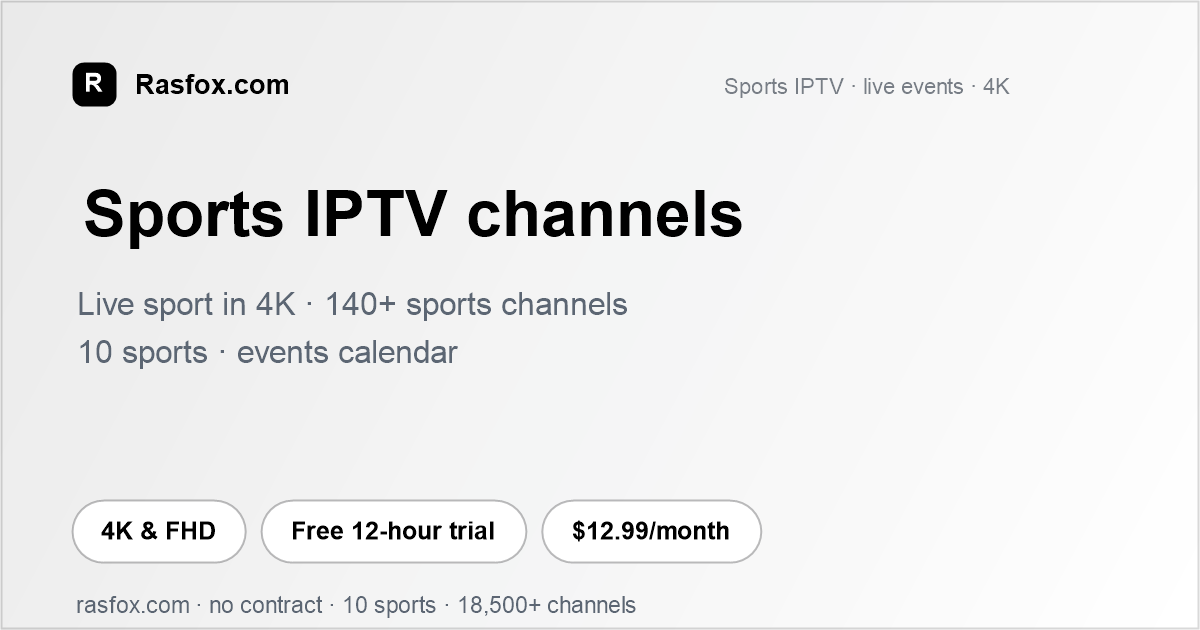
In this guide, we'll look at how IPTV works, how it transforms the way fencing families and general sports fans watch live events in the United States, what hardware you need, and how to tell a legitimate service from a risky one. We'll also show you why RasFox IPTV has become the go-to sports-first platform for viewers who refuse to miss a single bout, goal or lap.
What Is IPTV and How Does It Transform Live Sports Broadcasting?
IPTV stands for Internet Protocol Television. Instead of receiving channels through a coaxial cable or a satellite dish, your stream arrives over your regular internet connection — the same way Netflix or YouTube reaches your TV. The difference is that IPTV delivers live, linear channels, not just on-demand libraries.
For sports fans, that distinction matters enormously. Here's why:
- Far more channels than cable. A typical US cable package carries 150–300 channels. A quality IPTV service carries thousands, including international feeds that American providers simply never offer.
- Niche and Olympic sports included. Fencing, judo, table tennis, athletics, cycling — sports that get a five-minute highlight reel on cable are available as full live broadcasts on IPTV.
- No regional blackouts. You're not locked to a zip code. If a bout is being televised anywhere in the world, you can reach it.
- 4K and 50FPS streams. Modern IPTV platforms deliver high-bitrate feeds that look sharper than most cable boxes — critical when you're trying to see whether a blade landed on the strip.
- No contracts, no installation. No technician visit, no 24-month lock-in, no equipment rental fee.
In short: IPTV doesn't just replace cable. For sports, it outperforms it.
From the Piste to Your Screen: How IPTV Enhances the Fencing Experience
Fencing has a coverage problem. The sport is fast, technical and genuinely dramatic — yet in the United States, live fencing coverage is scattered across Olympic broadcast windows, occasional streamed World Championship feeds, and the athletic department pages of a handful of NCAA programmes.
IPTV solves this in three concrete ways.
1. You get access to international fencing broadcasts
Fencing World Cups are televised heavily in Europe, Latin America and parts of Asia. European public broadcasters, pan-regional sports networks and national federations all carry poules, tableaux and finals that never reach American airwaves. With IPTV, those feeds sit in the same channel list as ESPN — one remote, one interface, no VPN gymnastics.
2. You stop paying for five subscriptions to watch one event
The average American sports fan now juggles cable, a streaming sports tier, a league-specific pass and a combat-sports app. That's easily $120–$180 a month. A single IPTV subscription built around live sports consolidates all of it — football, combat sports, motorsport and Olympic disciplines — into one bill.
3. You can watch fencing and everything your family wants
Let's be realistic: not everyone in your house is watching épée. The best IPTV services pair deep sports coverage with mainstream entertainment, kids' channels, news and movies. That's what makes the switch practical for a whole household rather than just one obsessed fan.
So the bridge is simple: if you already care enough about fencing to follow the World Championships, you care enough about sport to want one platform that carries all of it live.
Deep Dive: The IPTV Landscape for Sports Fans in the United States
The US is, in many ways, the ideal market for IPTV. Broadband penetration is high, fibre and 5G home internet are widely available, and roughly 80% of American households have at least one connected TV device. Meanwhile, traditional cable subscriptions keep falling, and regional sports network pricing keeps climbing.
The result: American viewers are the fastest-growing IPTV audience in the English-speaking world. And the single biggest reason they switch is sports.
Where RasFox comes from — and why that matters
RasFox's roots are in radio: Radio Malena 89.1 FM, based at Venezuela 370 in Buenos Aires — a station steeped in tango, Argentine football culture and decades of live sports commentary. That background shaped everything. When the team moved into IPTV, it wasn't built as a generic streaming catalogue. It was built the way a sports broadcaster would build it: with total focus on sports channels and live sports events.
That heritage is also why RasFox supports the lusophone and Latino diaspora worldwide, with customer service in Portuguese and Spanish alongside English — a rarity in a market dominated by anonymous resellers.
Channels and competitions you get
For viewers in the United States, the lineup combines domestic sports networks with the international feeds that make IPTV genuinely different:
- US & global sports: ESPN, ESPN2, Fox Sports, DAZN, beIN Sports, Sky Sports, Eurosport, TNT Sports
- Football: Premier League, La Liga, Serie A, Bundesliga, Champions League
- Latin American football: TyC Sports, ESPN Premium, Fox Sports, DirecTV Sports — plus Globo, SporTV and Premiere for Brazilian viewers
- Portuguese football: Sport TV 1–6, Eleven Sports, Benfica TV, Porto Canal, DAZN Portugal
- Combat & motorsport: UFC, boxing, F1, MotoGP
- Multi-sport events: Olympic Games, World Championships, Pan American Games — including the fencing programme
The full package runs to 12,000+ live channels and 40,000+ on-demand titles, streamed in 4K at 50FPS where the source allows. Two simultaneous screens are included, so one person can be on the fencing final while someone else watches the game — on the same subscription, in the same house.
The buffering question
Every IPTV skeptic asks the same thing: will it freeze during the decisive moment?
It's a fair question, because cheap IPTV resellers oversell capacity and collapse during peak events. The difference with a properly provisioned service is infrastructure: load-balanced servers, multiple redundant sources per channel region, and auto-failover when a feed degrades. On a stable 25 Mbps+ connection, a quality sports IPTV feed should run smoothly with no buffering — including during a Champions League knockout night or an Olympic fencing final, when demand spikes hardest.
Hardware and Setup: What You Actually Need
One of the most attractive things about IPTV is how little equipment it requires. There's no dish, no coax run, no installer appointment. Here's the realistic setup for a typical American household:
The essentials
- Internet: 25 Mbps minimum for HD; 40–50 Mbps recommended for comfortable 4K. Fibre, cable broadband and 5G home internet all work.
- A device: Amazon Fire Stick, Android TV box, Apple TV, NVIDIA Shield, a Smart TV with an IPTV app, or a phone/tablet for watching on the move.
- An app or player: Provided by the service, or a standard IPTV player installed from your device's app store.
- Ethernet (optional but recommended): A wired connection removes Wi-Fi jitter — the biggest cause of micro-stutters during live sport.
Setup in four steps
- Choose your service and receive your login credentials.
- Install the player app on your device of choice.
- Enter your credentials and let the channel list populate (usually 2–5 minutes for a large lineup).
- Build a favourites list — fencing, football, UFC, F1 — so you're never scrolling on fight night.
If you want to test the whole setup before committing to anything, a 24-hour free IPTV trial is the smartest route: you get to check picture quality, channel availability and stability during a real live event, on your own internet connection, at zero cost.
Legal vs Illegal IPTV: Safety, Rules and Best Practices
This is the section most IPTV articles skip — and it's the one that matters most.
IPTV technology itself is completely legal. It's simply a delivery method, used by major telecoms, broadcasters and streaming platforms worldwide. What determines legality is licensing: does the operator have the right to redistribute the channels it carries?
Warning signs of an illegal or unsafe service
- Prices that are implausibly low (e.g., $5 for a full year of premium sports)
- No company information, no terms of service, no working support channel
- Payment only via untraceable methods, with no refund policy
- Aggressive "lifetime subscription" offers
- No trial period — legitimate services let you test before you pay
What a legitimate service looks like
- Transparent pricing and a clear subscription term
- A usable free trial so you can verify quality
- Real customer support with reasonable response times (ideally in your language)
- Server infrastructure designed for simultaneous high-traffic events
- No long-term contract locking you in
For American viewers, the safest approach is to choose an established provider with a visible identity, verifiable support and a no-contract structure. RasFox.com fits that profile: a sports-focused platform with Argentine broadcasting heritage, PT/ES/EN support, a 24-hour free trial, two simultaneous screens and no contract — so you can evaluate it properly before spending a dollar, and walk away if it doesn't deliver.
A few practical safety habits go a long way too:
- Never share your account credentials; choose a service with device limits you understand.
- Use a reputable payment method with buyer protection.
- Keep your player app updated — most buffering complaints trace back to outdated software.
- Test during a live event, not on a quiet Tuesday morning. Peak load is the real benchmark.
Why Sports Fans Are Making the Switch Now
The old model made you pay more for less: rising cable bills, shrinking sports coverage, blackouts designed around regional markets. IPTV inverts that. For a fraction of the cost, you get every major league, every combat sports card, every motorsport weekend — and the niche disciplines that cable never bothered with.
If you follow fencing, you know the frustration of watching a World Championship final through someone's shaky phone stream on social media. If you follow football, you know the pain of a 3 p.m. midweek kickoff you can't legally watch. IPTV is the practical answer to both.
And with a sports-first platform, you're not sifting through 12,000 channels to find the one that matters. You're opening an app, tapping your favourites, and watching live.
Frequently Asked Questions
Is IPTV legal in the United States?
Yes — IPTV as a technology is legal in the US. Legality depends on whether the provider holds distribution rights for the channels it offers. Choose a transparent, established service with published terms, real support and a trial period rather than an anonymous reseller offering implausibly cheap annual plans.
Can I watch fencing and other Olympic sports on IPTV?
Yes. This is one of IPTV's biggest advantages over cable. International sports networks, European public broadcasters and pan-regional feeds carry fencing World Cups, World Championships and full Olympic coverage that US cable packages rarely include. On a sports-focused IPTV lineup, those channels sit alongside mainstream networks.
How many channels and on-demand titles are included?
A quality sports-first IPTV package typically includes around 12,000 live channels and 40,000+ VOD titles, many streamed in 4K at 50FPS. Coverage spans football (Premier League, La Liga, Champions League, Brasileirão, Libertadores), combat sports (UFC, boxing), motorsport (F1, MotoGP) and major multi-sport events.
What internet speed do I need for buffer-free 4K sports?
25 Mbps is the practical minimum for reliable HD streaming. For 4K sports — especially fast-motion events like fencing, football or F1 — 40–50 Mbps is recommended, ideally with a wired Ethernet connection to your main viewing device to eliminate Wi-Fi interference.
Is there a free trial before I subscribe?
Yes. RasFox offers a 24-hour free IPTV trial so you can test picture quality, channel availability and stability on your own connection before paying. It's the only honest way to judge an IPTV service — test it live, during a real event, and decide for yourself.
How many devices can I use at the same time?
Standard plans include two simultaneous screens, which covers most households — one screen for the live match, one for everything else. No contract is required, so you can scale up or cancel without penalty.
Final Thoughts: One Subscription, Every Live Event
Fencing taught us something the rest of the sports world is slowly learning: the best moments are the ones you have to be watching live. A touch lands, a decision goes to review, a final ends 15–14 — and if you weren't there, no highlight reel does it justice.
IPTV removes the barriers that used to sit between you and those moments. No cable contract. No regional blackout. No five-app circus. Just a stable 4K stream, a sports-first channel list, and a platform that understands live events are the whole point.
If you're ready to see the difference for yourself, start with the free trial, test it during a genuine live event, and judge it on picture quality and stability alone. That's exactly what a sports-first IPTV service should be measured on — and it's why RasFox built its platform around the sports fan first, and everything else second.
Ready to watch? Get your 24-hour free trial at RasFox.com and put it to the test tonight.